
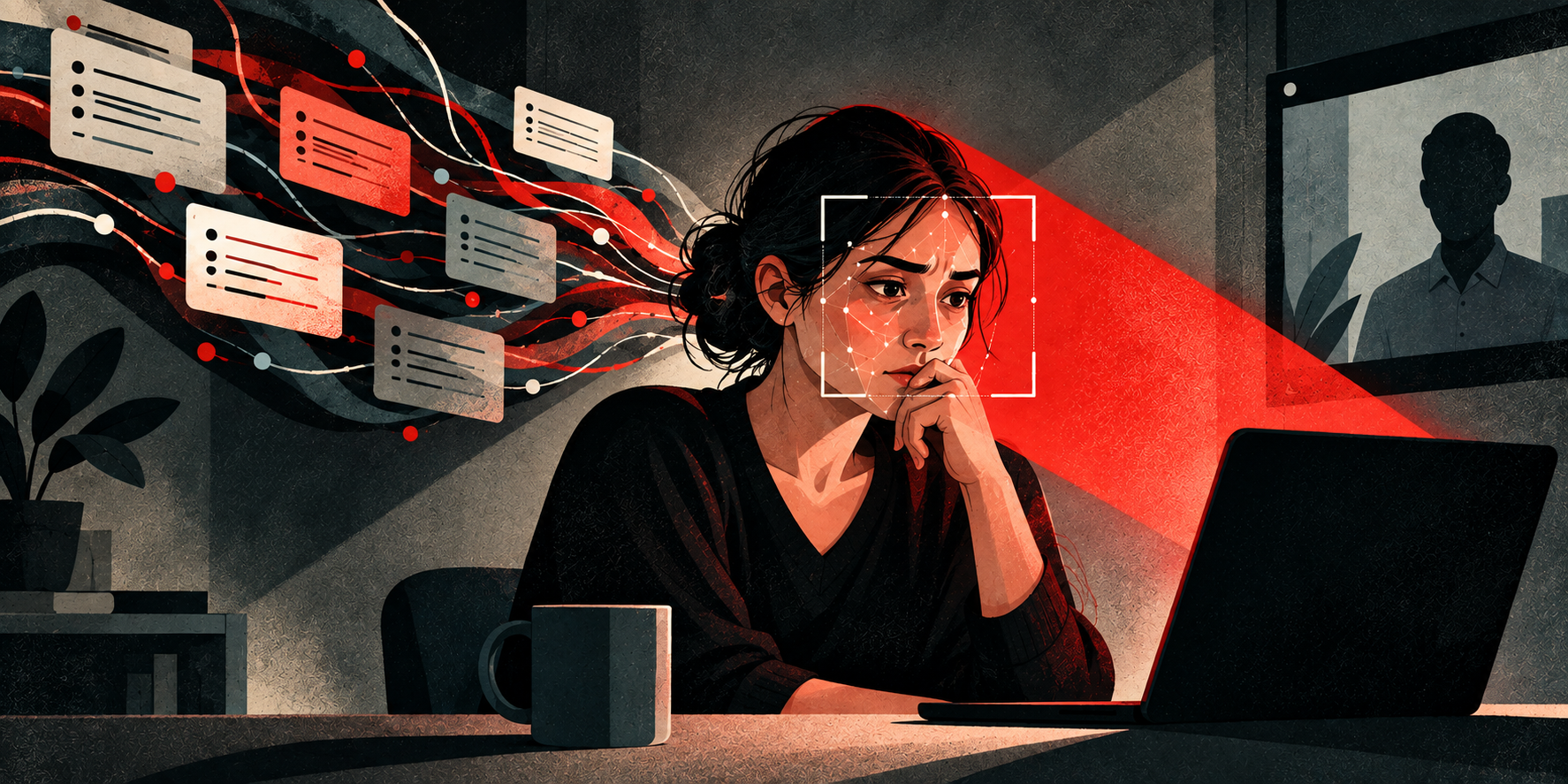
One AI may be feeding the candidate answers.
Another AI may be watching the candidate's eyes to determine whether those answers came from AI.
Somewhere in the middle, two human beings are supposedly conducting a job interview.
This is where hiring appears to be headed: artificial intelligence monitoring artificial intelligence while the applicant attempts to look appropriately human.
The concern behind it is real. Candidates can now use "interview copilot" tools that listen to questions and quietly generate answers in real time. Other products promise undetectable assistance with coding tests, technical interviews and behavioral questions.
Then there are more serious forms of deception: proxy candidates, fabricated identities, deepfake video, cloned voices and people pretending to live in countries where they do not live.
A Gartner survey of 3,000 job candidates found that 6 percent admitted to interview fraud — either impersonating someone else or having someone impersonate them. Gartner predicts that by 2028, one in four candidate profiles worldwide could contain material identity misrepresentation.
That does not mean one-quarter of job applicants will be international spies wearing Mission: Impossible masks. Gartner's prediction concerns materially false candidate profiles. But it is more than enough to make employers nervous.
The Justice Department has already documented schemes in which North Korean IT workers used stolen or fabricated identities to obtain remote positions at American companies. One collection of cases affected more than 136 companies, compromised the identities of at least 18 Americans and generated more than $2.2 million for the North Korean government.
That is not résumé embellishment. That is organized infiltration.
Now the Interview Is Watching You
Employers are responding with a new generation of fraud-detection systems.
These systems may compare faces and voices across multiple interviews. They can look for lip-sync problems, possible off-screen prompting, synthetic speech, unusual response delays and inconsistencies between what a candidate says at different stages.
Some monitor eye movements, browser activity and whether an answer sounds suspiciously polished or mechanically structured.
The software may not declare someone a fraud. It may simply assign a risk level or flag certain moments for human review.
That sounds reasonable until you consider what might qualify as suspicious behavior.
A candidate pauses before answering. Someone looks away from the camera while thinking. A nervous applicant gives an overly structured response. A person with a disability uses assistive technology. Someone interviewing in a second language keeps prepared notes nearby. A qualified candidate has poor lighting, an unreliable connection or a cheap webcam.
None of these things establishes fraud. But each could become another data point in a system designed to identify abnormalities.
The résumé scanner was apparently only the warm-up act.
The Wall Street Journal recently reported that some employers are asking remote candidates to remove virtual backgrounds, pan their cameras around the room, wave a hand in front of their faces and complete live assignments while sharing their screens. Some companies are checking eye movements, IP addresses and browser activity.
Candidates are no longer merely being interviewed.
They are being authenticated.
The AI Arms Race
This is the circular logic consuming modern hiring.
Employers automated applications. Candidates responded by using AI to produce and tailor more applications. Employers received more polished résumés than their diminished recruiting staffs could reasonably evaluate, so they added more automated screening.
Candidates then used AI to prepare for assessments and interviews.
Employers became less confident that interview answers reflected genuine ability, so they began deploying AI to detect the candidate's AI.
Each side's solution becomes the other side's problem.
The result is not a more efficient labor market. It is a technological arms race built on declining trust.
Honest candidates get trapped in the middle. They must prove not only that they can do the work, but that they are real, that their experience is real, that their answers belong to them and that their perfectly ordinary nervous behavior is not evidence of an elaborate conspiracy.
Proof First or Surveillance First
Employers have another option.
They can ask candidates to show what they have done, explain how they did it and demonstrate how they would approach the actual work.
A marketer can present a campaign and explain the choices behind it. A project manager can walk through a difficult assignment, including what went wrong. A financial professional can analyze a realistic business problem. A software developer can review existing code and discuss how it might be improved.
AI can manufacture a smooth answer. It is harder to manufacture detailed knowledge of work you actually performed — especially when an informed interviewer asks intelligent follow-up questions.
That is the promise of proof-first hiring: less reliance on claims and more attention to evidence.
But proof-first hiring could instead become surveillance-first hiring. Candidates may be required to demonstrate competence while software simultaneously measures whether they blink, pause or look toward the wrong corner of the screen.
Employers will have to decide what they are really trying to establish.
Can the candidate perform the job?
Or can the candidate successfully perform normality for a machine?
What Candidates Should Ask
Job seekers should assume that virtual interviews may be evaluated in ways that are not obvious.
That does not mean trying to game the detector. It means being prepared to establish authenticity. Know your own résumé well enough to discuss every important claim. Be ready to explain your decisions, your precise role and the result. Keep work samples, case studies and other evidence that supports what you say.
If you use AI to prepare, use it to organize your thinking — not to replace it. An answer grounded in real experience will usually survive follow-up questions. A borrowed answer may collapse as soon as the interviewer wanders beyond the script.
Candidates should also feel entitled to ask:
- Will this interview be recorded?
- Will AI be used to analyze it?
- What information will be collected?
- How long will that information be retained?
- Will a person review any automated assessment before a decision is made?
Those are not unreasonable questions. If an employer intends to analyze your face, voice or behavior, you should know about it.
Employers have a legitimate reason to protect themselves from impersonation and organized fraud. They also have a responsibility not to treat every applicant as a suspected criminal.
AI may help verify identity. It may identify inconsistencies. It may surface something worth examining.
But it cannot decide whether two human beings should trust each other.
Eventually, somebody is going to have to conduct an actual job interview.
Sources: Gartner (July 2025); U.S. Department of Justice (June 2025); The Wall Street Journal (August 2026); Phenom (May 2026); SiliconIndia (September 2026). The Phenom material describes the company's own fraud-detection products and should be understood as vendor-reported information rather than independent validation.