
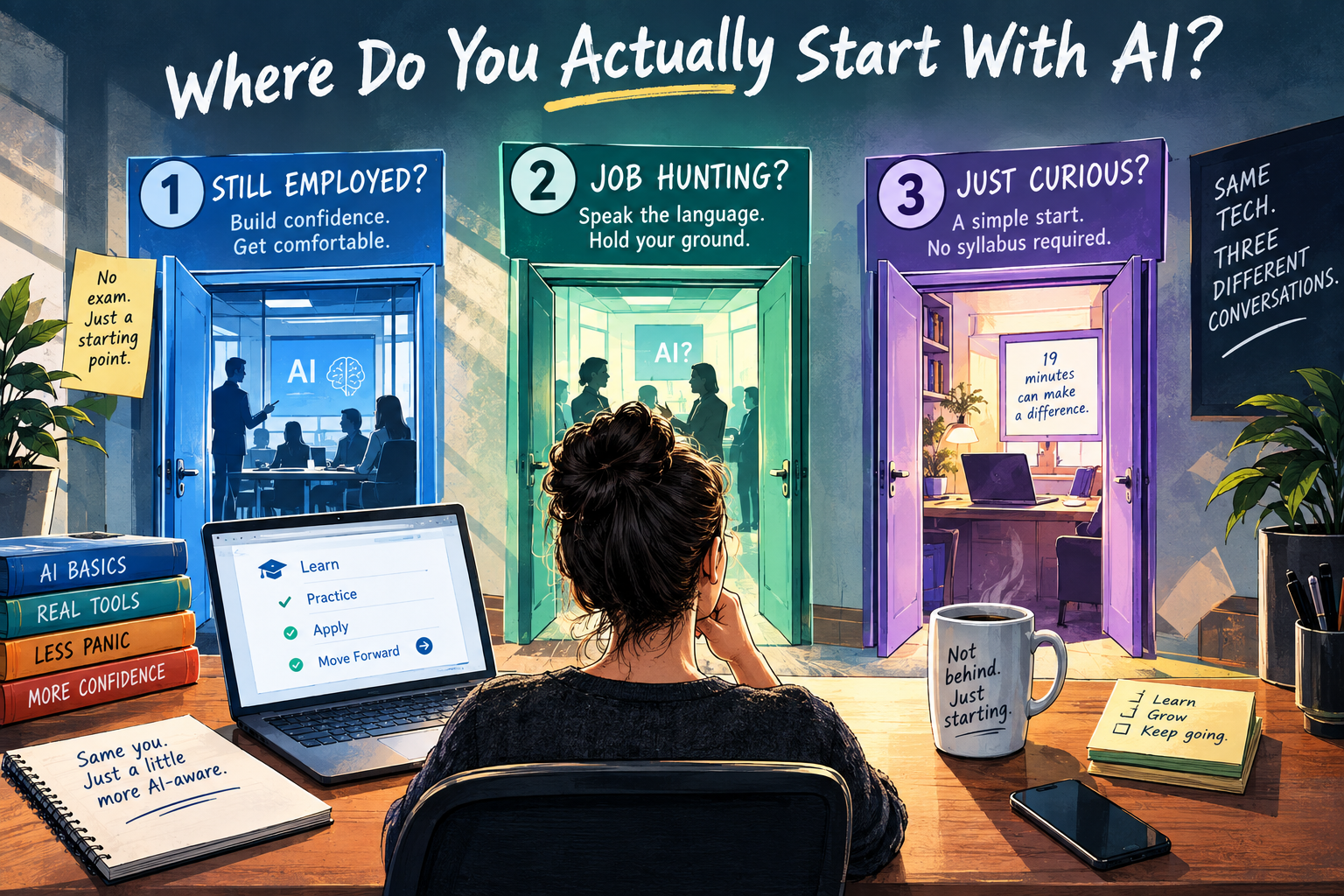
You've heard you need to know this. Everyone has. What nobody tells you is that "AI" isn't one subject — it's three completely different conversations depending on where you're standing, and most of the panic comes from getting handed the wrong one.
Pick the paragraph that sounds like your week.
You've got a job, and there's a cold little feeling when AI comes up in a meeting. Nobody's forcing anything yet, but you'd like to stop flinching. Start with Section 1.
You're job hunting, and you're starting to worry it'll come up in a screening. You're already in motion — this gets you conversational enough not to get caught flat-footed. Start with Section 2.
You haven't started anything, don't know where to start, and don't want a syllabus. You need nineteen honest minutes, not a specialization. Start with Section 3.
Read the one that fits. Skip the other two, or come back to them later — nothing here requires doing all three.
1. Still Employed, Quietly Behind
Somewhere in the last year or two, "AI" stopped being a thing happening in other departments and started showing up in your meetings. Maybe it was a stray comment from your manager. Maybe a colleague mentioned some tool like it was obvious you'd know it too, and you nodded along and made a mental note to look into it later, and later never quite arrived. That's normal. Almost everyone in your position is nodding along to something they haven't actually touched.
Here's the part nobody says out loud: you're not behind in the way it feels like you're behind. There's no exam on Friday. Nobody's tracking whether you started this month or next spring. The anxiety around AI right now is mostly manufactured by people selling courses, consultants, and think pieces who need you to feel urgent so you'll buy the urgency-relief product. You don't need urgency. You need one lazy Saturday morning and a browser tab.
The first thing:
Google built a course called AI Essentials — about ten hours total, self-paced, no technical background required. The content itself is free to work through; there's a paid option if you want the shareable certificate at the end, but that's not the reason to start. The reason is that ten hours from now, you'll be someone who's actually used the tools everyone's been vaguely referencing instead of someone still nodding along. You'll know what large language models do and don't do well, you'll have written a few prompts yourself, and the cold little feeling in meetings will mostly be gone — not because you became an expert, but because the mystery evaporates the moment you've touched the thing.
Do it in one sitting or spread it across a week. Nobody's checking.
If it turns out you want to go further — sharper business applications, or you're starting to think about how this affects your own job specifically — Section 2 picks up from here whenever you're ready.
2. Actively Job Hunting, Feels Exposed
You're already in the fight — sending out applications, doing screenings, trying to sound like the version of yourself that gets hired. And somewhere in the last few rounds, you noticed AI questions sliding into the mix. Not always directly. Sometimes it's just "walk me through your workflow," and you realize halfway through the answer that you don't have a good one for the AI part, because you've never had to have one before.
This is a different problem than not knowing the field exists. You know it exists. You just don't have footing yet, and footing is what gets you through a follow-up question without stalling. That's fixable fast, and it doesn't require becoming technical.
The first thing:
DeepLearning.AI's AI For Everyone, built by Andrew Ng — free to audit, entirely non-technical, framed around business use rather than engineering. It won't turn you into an AI person. It'll make you someone who can hold a real conversation about what these tools do, where they're useful, and where they fall apart, which is exactly the register most screening conversations actually operate in. Nobody in a first-round interview is testing your math. They're testing whether you freeze or hold your ground.
Once you've got that footing, the harder question is what happens when they ask you to prove it — not just talk about AI, but show you've actually used it and know the difference between real use and a rehearsed line. That's a sharper conversation, broken down by job function, and it's worth a look before your next interview, not after.
3. Curious but Overwhelmed, Hasn't Started
If you've gone looking for a starting point already, you know the problem isn't a shortage of resources. It's an oversupply of people performing expertise at you — breathless listicles, LinkedIn posts promising "8 courses every professional needs," half of them written by someone who's finished none of them. You closed the tab. That was the correct response.
Here's the thing almost nobody tells you: a lot of the people using terms like "AI-native" confidently in meetings don't fully know what they mean either. The field is confusing on purpose, partly because it's genuinely new and partly because confusion is good for business — mystified people buy more courses. You're not behind some invisible curve. You just haven't had anyone hand you a small, honest first step instead of a syllabus.
The first thing:
Elements of AI, built by the University of Helsinki with no product to sell you — start with just the introductory module. About nineteen minutes. No account required to preview it, no assumption you'll finish the full course, no badge you're expected to care about. Just enough to go from "I have no idea what this even is" to "okay, I get the shape of it now."
If nineteen minutes turns into curiosity, Section 1 is the natural next stop — nothing you have to commit to today.
A Quick Note on Pricing
As of October 1st, 2026, the three programs linked here are free. But we'd rather you double-check details on the providers' own pages before you commit.