
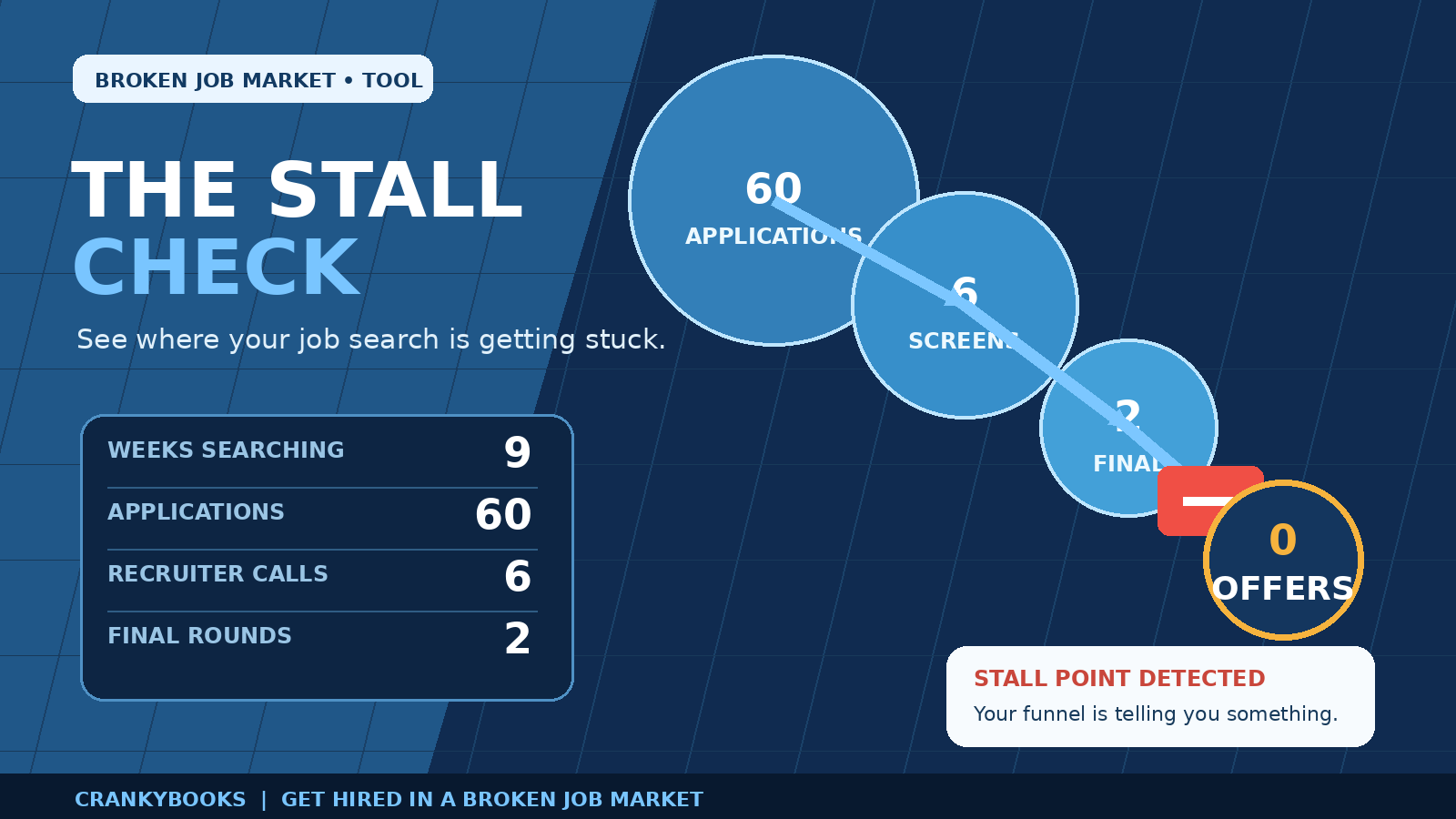
There's a difference between a slow search and a stalled one, and most people never stop long enough to tell which one they're in. So they do the only thing that feels like progress: more of the same. Another twenty applications into the void. Another pass at a resume that was never the problem. Motion gets mistaken for movement, and weeks disappear that way.
The instinct makes sense. When nothing's landing, doing more feels safer than stopping to ask why. But if the reason you're stuck is something specific — wrong targets, a pitch that doesn't land, an interview process that keeps eating you alive in the final round — then doing more of what isn't working just produces more evidence that it isn't working. It doesn't fix anything. It just makes the silence louder.
The fix starts with knowing which kind of stuck you are. Not a vibe. Numbers. How many applications, how many calls back, how many finals, how many offers. Run those against each other and a pattern shows up whether you want to see it or not — and it's rarely the pattern people assume going in.
Once you know where the funnel actually breaks, you can do something useful with the rest of it: sit down with people who'll tell you the truth, not just the ones who'll tell you it's fine. Look hard at how you're presenting yourself — the resume, the story, the paperwork backing it all up — with fresh eyes instead of the ones that have read it forty times and stopped seeing it. Try something you haven't tried yet, instead of trying the same thing harder.
A stalled search isn't a character flaw. It's a diagnosable problem, and most of them are fixable once you know what you're actually looking at.
Run the Stall Check below. Put in your real numbers — applications, screens, finals, offers — and it'll tell you where your funnel actually breaks, not where you assume it does.