
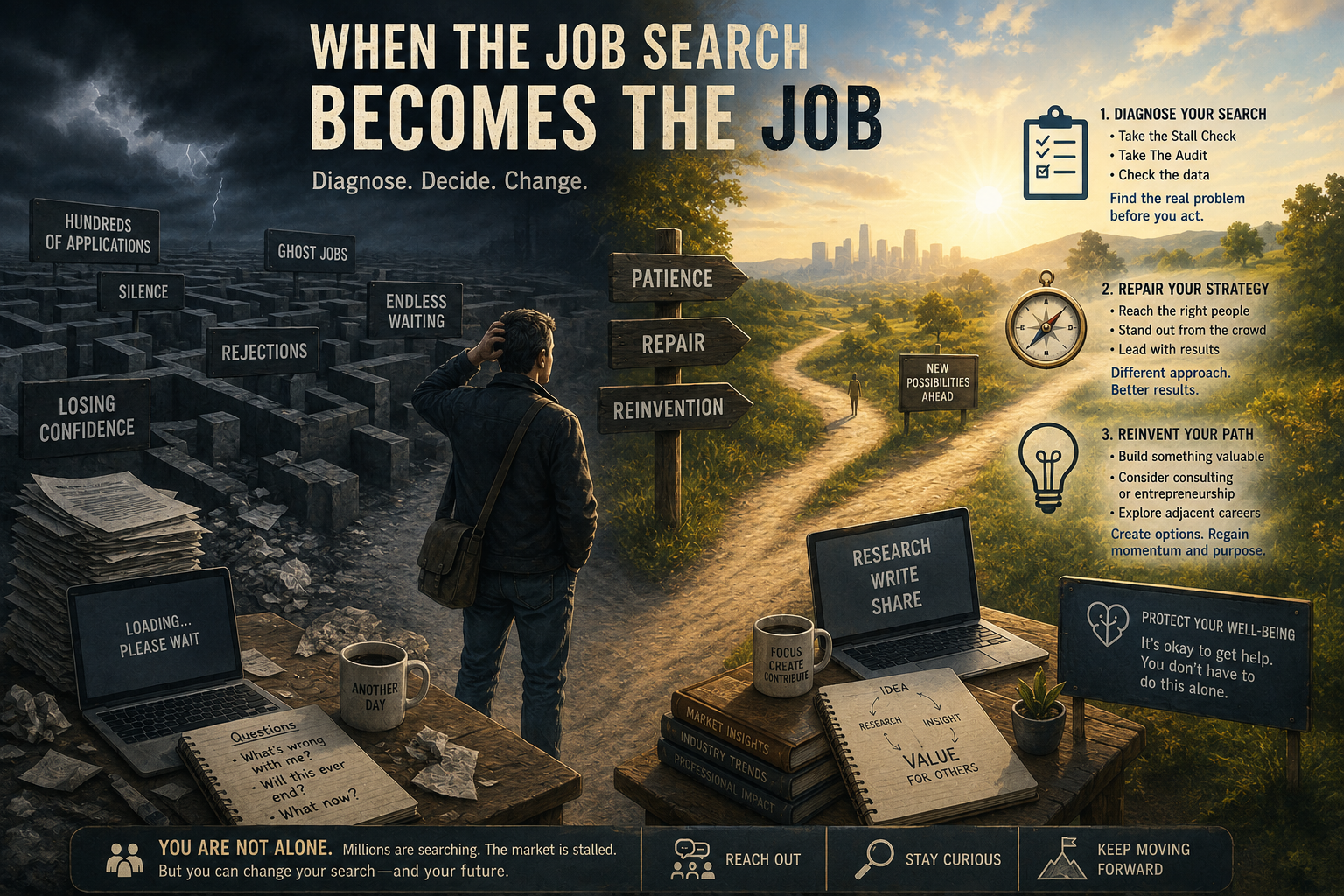
There is a point in a long job search when the question changes.
At first it is: When am I going to find a job?
After six months, nine months, a year, sometimes longer, it becomes something more unsettling:
What if I don't?
That is where a growing number of Americans find themselves.
In July, about 1.8 million people had been unemployed for 27 weeks or longer. They represented 25.5 percent of all unemployed Americans. And roughly 1.18 million people had been unemployed for a year or more.
Those numbers are particularly striking because the country is not in the sort of deep recession we normally associate with long stretches of unemployment. The headline unemployment rate was 4.1 percent in July. Yet hiring has slowed, payroll employment declined by 23,000 that month, and the government revised May and June payroll growth downward by a combined 103,000 jobs.
Recent reporting by Business Insider put faces on the problem. Experienced professionals described searches lasting 18 months or two years, repeated interviews and rejections, financial strain, and the creeping suspicion that perhaps something about them had become unemployable. Some eventually took jobs far removed from their previous careers or at substantially lower pay.
That last part matters.
Long-term unemployment is not simply a financial event. Work occupies an enormous amount of psychological real estate. It provides structure, colleagues, status, accomplishment and, for many people, a large piece of identity. Take that away for a year while simultaneously subjecting somebody to rejection, silence and the occasional seven-round interview that ends with a form email, and eventually the machinery starts rattling.
People withdraw. They become embarrassed about explaining their situation. Confidence erodes. Every rejection starts looking like evidence.
And that is precisely when you need to stop looking at yourself as the problem and start looking at the search as a problem to be diagnosed.
First, find out where you actually are
If your search has stalled, don't begin by sending another fifty applications. Begin with an audit.
Our Stall Check is designed to help identify where a search is actually breaking down: Are you failing to generate conversations? Getting conversations but no interviews? Getting interviews but not advancing? Reaching final rounds but never receiving the offer?
Then take The Audit, which looks more broadly at the condition of the search — your finances, résumé, targeting, outreach, interviews and overall strategy.
And if you are wondering whether your timeline is normal, use the Job Search Duration Tool to benchmark how long searches are actually taking in your field and level.
Before deciding that your own search is uniquely catastrophic, look at the numbers and at the prospects for your occupation and market. The objective is not to generate another score to worry about. It is to determine whether your search needs patience, repair or reinvention.
Those are different problems.
Maybe you keep going
There is nothing irrational about continuing the search you have already begun.
You can do everything reasonably well and still not have a job. Hiring involves timing, budgets, internal candidates, reorganizations, nervous executives and plain dumb luck. The job you need may be sitting behind the next door you knock on — under a rock you haven't turned over yet, or buried somewhere behind a corporate hiring manager's desk.
So persistence still matters.
But persistence should not mean repeating exactly the same process indefinitely and calling it determination.
If you have been searching for months, go back through the machinery. Are you reaching the people who can actually hire you, or primarily feeding applications into job boards? Are you targeting companies intelligently? Are you having enough conversations with people in your field? Does your résumé tell an employer what you have accomplished, or mostly where you worked and what titles you held? If you are getting interviews, where are you losing them?
Look for the break in the pipe.
Give them something the other candidates don't have
Then ask a harder question: Why should anybody remember you?
For many professional jobs, the serious candidates eventually begin to look remarkably similar. Comparable degrees. Comparable employers. Comparable titles. Comparable résumés announcing that they are strategic, collaborative and results-oriented.
You need some daylight between yourself and everybody else.
One approach we discuss in Get Hired in a Broken Job Market is to build something visible. Suppose you are pursuing senior jobs in an industry you know well. Instead of merely telling prospective employers that you understand the business, prove it.
Conduct a small research project. Survey people in the field. Analyze an emerging problem. Write a short white paper. Produce a thoughtful examination of a trend affecting the companies you hope to join.
It doesn't need to be 40 pages long or destined for the Harvard Business Review. It needs to be good.
You might write an article for a trade publication or industry website. Or publish it yourself. Then send it to people in the field with a simple note saying you thought they might find it interesting and inviting them to pass it along.
Now you are no longer simply another unemployed person asking whether somebody knows of an opening. You are contributing something.
Better still, producing it gives you a legitimate reason to talk with people. Interview executives. Ask specialists for their observations. Get reactions to your conclusions. You are building knowledge and relationships at the same time.
The point isn't to become famous. It is to become findable, credible and memorable.
In a sea of candidates waving nearly interchangeable résumés, you have stuck your hand above the water and said: Here I am.
Take another hard look at the résumé
Long searches also justify reopening a document many job seekers stopped seriously examining months ago.
Your résumé may be perfectly competent. That doesn't mean it is doing its job.
Look at it as a stranger would. Is most of the visual and intellectual weight devoted to company names, dates, titles and responsibilities? Or can somebody quickly see what happened because you were there?
Revenue increased. Costs declined. A product launched. A department improved. Customers stayed. A broken operation began working. Something changed.
Results give an employer evidence. Job descriptions give an employer history.
If you have been applying for months without sufficient response, this is a reasonable time to get another set of experienced eyes on the résumé. A good coach, recruiter or knowledgeable hiring manager may see something you no longer can.
And perhaps the answer isn't another version of your old job
There is another possibility, and it deserves more consideration than job seekers usually give it.
Maybe this is the moment to do something else.
That does not mean throwing away thirty years of experience or announcing on LinkedIn that you have finally discovered your passion for artisanal goat cheese.
It means giving yourself permission to examine the alternatives.
Could you consult? Could you acquire a small business? Could you join an existing retail or service operation? Could a hobby, technical skill or long-standing interest become the basis of something commercially viable? Could you teach, advise, freelance or build something? Could you move into an adjacent field where your existing experience gives you an advantage?
There is no requirement that you formally end your job search before exploring any of these. In fact, that is the point.
You can keep looking while building something else.
The psychological difference can be enormous. Instead of waking every morning waiting for strangers to decide whether you have value, you have work to do. You are learning something, producing something, meeting people and exercising abilities that months of unemployment may have convinced you were disappearing.
And one of those side roads may turn out to be the road.
Protect the person conducting the search
Finally, there is a boundary between the ordinary discouragement of a miserable job search and something more serious.
If anxiety is becoming overwhelming, if you are withdrawing from your family and friends, if your behavior has changed in ways that concern you or the people around you, or if you are finding it increasingly difficult to function normally, don't treat that as another career problem to solve with a better spreadsheet.
Talk to somebody qualified to help.
A year of unemployment is prolonged stress. If the strain is becoming more than you can comfortably manage, seeking professional help is a practical response, not a career judgment.
The question changes again
Long-term unemployment can create a peculiar paralysis. You become so invested in getting back to where you were that every day becomes another attempt to recreate the life you had before the layoff, resignation or corporate reorganization.
Maybe that remains exactly the right objective. But after six months or a year, you have earned the right to challenge the premise.
Keep searching, but search differently.
Reach people instead of portals. Show employers evidence instead of adjectives. Create something that demonstrates what you know. Rebuild the résumé around what you have actually accomplished. Explore consulting, entrepreneurship and adjacent careers without requiring yourself to make some grand irreversible declaration about the rest of your life.
And above all, don't confuse endurance with strategy.
Sometimes the answer really is behind the next door.
But after you have knocked on the same door 200 times, it is reasonable to start looking around the building.
Tools referenced in this article:
- Stall Check — Identify exactly where your job search funnel is breaking down
- The Audit — A broader self-assessment of your overall search strategy
- Job Search Duration Tool — Benchmark how long searches are actually taking at your level and field
Sources:
- Business Insider — "Unemployed Americans say they're stuck in a job-hunting nightmare," Sept. 3, 2026
- U.S. Bureau of Labor Statistics — Employment Situation, July 2026