
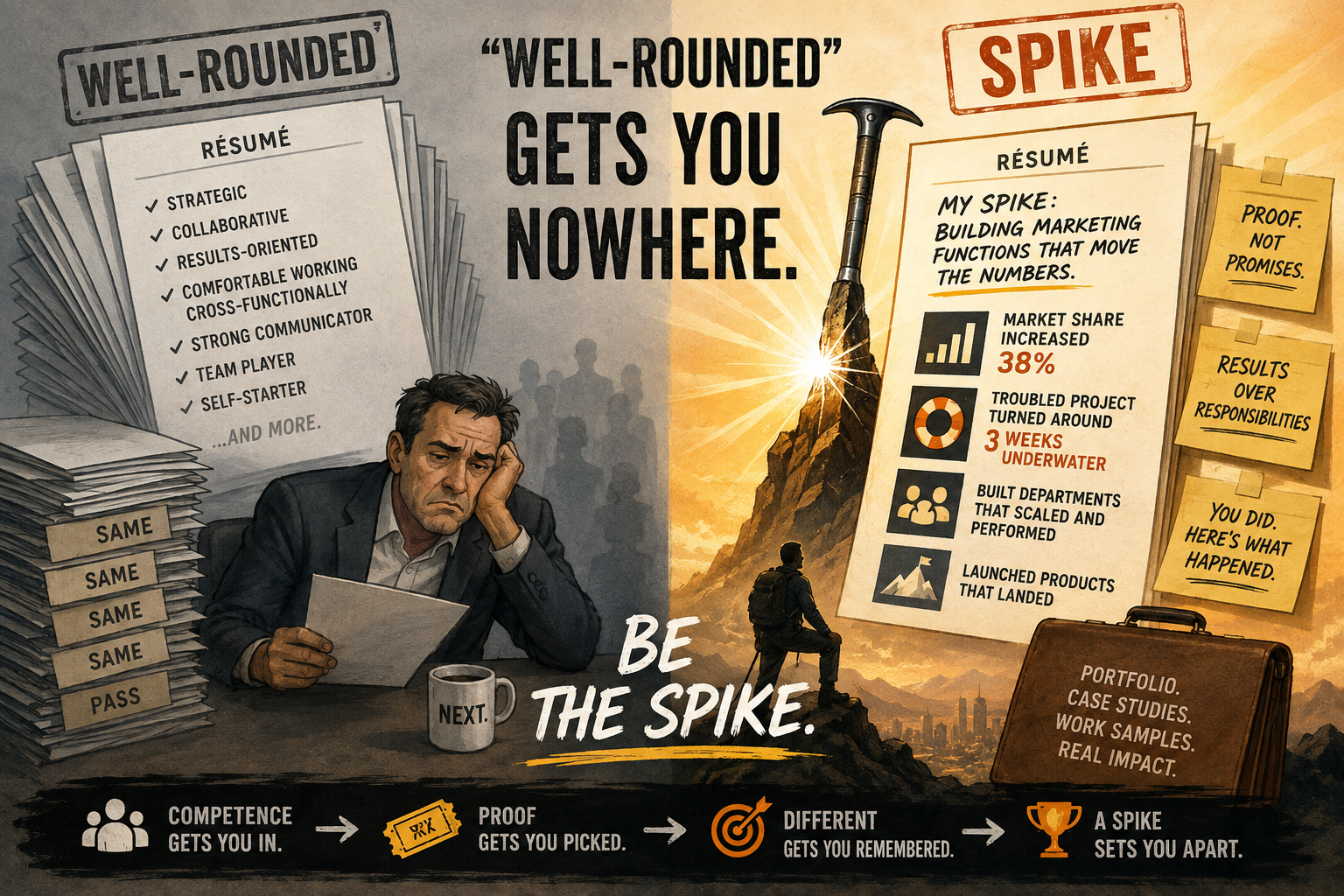
Why "well-rounded" is the compliment that gets you nowhere.
I spent more than a decade hiring people for a living, and I can tell you the exact moment a candidate loses me. It's not a typo. It's not a weak handshake. It's the paragraph where they describe themselves as strategic, collaborative, results-oriented, and comfortable working cross-functionally — and I realize I have read that same paragraph, verbatim in spirit if not in word, forty times that week.
Nothing about it is wrong. That's the problem. It's not wrong; it's just wallpaper. You could staple it to any résumé in the stack, and nobody would notice it had moved.
Somewhere along the way, an entire generation of job seekers got the memo that the safest résumé is the smoothest one — no sharp edges, no weird gaps, no claim you'd have to defend under direct questioning. So, they sanded themselves down until they were, functionally, indistinguishable from the guy in the next cubicle. Congratulations. You are now extremely well-rounded and completely forgettable, which in a hiring market this crowded amounts to the same thing as invisible.
Silicon Valley, because it cannot resist recycling an old idea, calls the antidote a "spike." A spike is the thing you do unreasonably well — the ability that shows up so consistently across your career that people started handing you the same kind of fire to put out, job after job, without being asked twice.
The term is not new. The underlying truth is not new, either. Employers have always hired for the sharp thing, not the smooth thing. What's changed is the noise. Applications are one click now. Résumés are AI-polished into a uniform gray paste. Everyone is strategic, everyone is a self-starter, everyone has apparently led cross-functional initiatives from the moment they left college. When every candidate sounds identical, the hiring manager isn't looking for competence anymore — competence is assumed, it's the price of admission — they're looking for the one thing that makes you different from the pile.
And here's the good news: you almost certainly have that thing already. You've just buried it under a layer of résumé Novocain because someone told you sounding "professional" meant sounding like nobody in particular.
I built marketing departments from nothing more than a budget line and a bad org chart. Along with my outstanding team, I took financial products so dense a customer would need a law degree to understand them and turned them into something a salesperson could pitch in ninety seconds without lying. Different jobs, different industries, different decades — but underneath it, the same move every time: look at a business, find the gap nobody's owning, build the structure and the people to close it, and stick around long enough to watch the numbers move.
That's a spike. And it only counts because I could prove it — market share that moved, launches that landed, departments that worked better after I got my hands on them. Take away the proof, and it's just a guy telling you he's good at his job, which is the least persuasive sentence in the English language.
You are not going to find your spike on a personality quiz, and you are not going to find it by hiring a résumé service that renames you a "visionary change agent" for $299. You'll find it the boring way — by noticing what keeps landing on your desk. Who calls you when the client is furious. Who hands you the project that's three weeks behind. Who trusts you with the account nobody else could keep. That pattern, repeated enough times across enough jobs, is a reputation, and it's been forming whether you noticed it or not.
Naming it is the easy part. The hard part — the part almost everyone skips — is proving it. This is where I get genuinely irritable about résumé writing, because most of them are constructed entirely out of responsibility, not result. Managed marketing campaigns. Oversaw client relationships. Led cross-functional teams. Every one of those lines tells me where you sat. None of them tells me what happened while you were sitting there.
Call it Proof-First Hiring. The idea is simple enough to fit on an index card: stop describing the chair, start describing the fire you put out from it. You didn't manage a campaign — response climbed 38 percent. You didn't oversee a troubled project — you found it three weeks underwater and dragged it back to shore. You didn't work in sales — you took a territory everyone had quietly given up on and gave it the best year it had had in a decade.
The proof doesn't have to live on the résumé itself, either — a portfolio, a case study, a work sample, even a well-told story in an interview will do the job. A recent graduate without a decade of receipts can point to a research project, an internship where they actually moved something, a volunteer effort they saved on sheer will. Someone changing careers entirely can still travel light with a spike — the ability to learn a complicated system faster than anyone expects, or to talk a skeptical client off a ledge, tends to survive the move to a new industry intact, even if the vocabulary around it changes.
None of this requires reinventing yourself as a LinkedIn thought leader with a personal brand and a ring light. It requires the opposite, honestly — less performance, more evidence. Competence is the entry fee. Everyone at the table has already paid it. What gets you picked is the one piece of proof that says, plainly and without decoration, here is something I did that most people can't, and here's what happened when I did it.
The résumé that gets remembered isn't the one with the fewest flaws. It's the one with the sharpest point.